
Age of Innovation: a Terra Mystica game
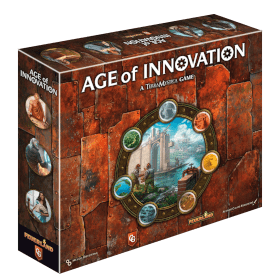 Twelve factions, each with unique characteristics, populate this world of varying terrains. Here you will compete to erect buildings and merge them into cities.
Each game allows you to create new combinations of factions, homelands, and abilities so that each game isn't the same as another.
You control one of these factions and will terraform the game map's terrain into your homelands where you can erect your buildings.
Number of players: 1 - 5
Game duration: 52 mn
Complexity: 4 / 5
Play Age of Innovation: a Terra Mystica game and 1365 other games online.
No download necessary - play directly from your web browser.
With your friends and thousands of players from the whole world.
Free.


Play Age of Innovation: a Terra Mystica game and 1365 other games online.
No download necessary - play directly from your web browser.
With your friends and thousands of players from the whole world.
Free.
Rules summary
Overview
Age of Innovation is a civilization-building game for 2 to 5 players. The goal is to spread your faction out as much as possible on the map. To do this, you'll have to terraform certain lands to make them suitable habitats for yourself (but not for others). At the same time, you must maintain proximity to other factions, but not let them limit you. As the game progresses, you'll terraform the land, build new buildings, and gain ranks in various Science Disciplines. The player with the most points after six rounds wins!
If you've ever played Terra Mystica (also available on BGA), this shares the same ruleset. See "Differences Between Age of Innovation and Terra Mystica" for more details.
Game Area Components
At any given moment, each player will have the following resources:
- Tools: White cubes. Usually earned from Workshops and can be spent to build new Buildings or terraform hexes.
- Coins: Usually earned from Guilds and from taking bonus tiles not chosen by other players. Can be spent to build new buildings.
- Scholars: Meeples. These are usually earned from Schools and Universities. Can be spent to increase your level in a Discipline and to upgrade your terraforming and Sailing.
- Power: Purple discs are placed in three bowls, labeled I, II, and III. Power is typically gained from Guilds, Palaces, and from other players building near you.
Players also have the following things in or near their faction boards:
- Buildings: The cost to build each building is given underneath it. When a building is in play, it exposes resources, which can then be earned during the income phase.
- Faction Terrain Cycle: Your faction's Native terrain is at the top. All others are in a circle around it, separated by spades. Your buildings can only be placed in your faction's Native terrain. On this circle, the closer another terrain is to your Native terrain, the fewer spades needed to terraform it into your Native terrain.
- Spade Exchange Rate: The higher this is, the fewer Tools are needed to terraform a space.
- Sailing: The higher this is, the more river spaces you can skip for adjacency.
- Innovation Tile slots: Innovation Tiles that you purchase are placed here. There are spaces for three.
The board as a whole contains the following features:
- Game Map: Self-explanatory.
- Round Tracker: There are six rounds in the game, each represented by a tile. During each round, building a specific building or taking a specific action awards bonus points. At the end of a round, you will receive an additional bonus based on how far you've advanced in a Discipline (except during the last round).
- Power Actions: Each provides a bonus when used, and can be claimed by any player for the appropriate power cost. These can each be used once per round.
- Science Display: There are four Disciplines: Banking (yellow)
 , Law (blue)
  , Engineering (brown)
  , and Medicine (gray)
  . Players receive a bonus at the end of each round based on their progress here. At the end of the game, the player who advanced the furthest gets additional points.
 - Round Bonus Tiles: These are worth additional income or bonus points. At any given moment, each player will claim one of them, then exchange them when they pass for the round, so there will be three unclaimed ones to choose from.
- Innovation Tiles: These grant you special abilities, additional points, or additional Buildings. They require you to pay a certain combination of books (gray books are any color) and 5 coins if you have not built a Palace.
- City Tiles: These are worth bonus points and some other one-time bonus. They are claimed when a player builds a City (4+ adjacent Buildings with 7+ power).
Setup
Before the game begins, each player chooses from seven randomized sets to determine their Planning Display (Native terrain), Round Bonus tile, and Faction.
Gameplay
Rounds
Age of Innovation is played across six rounds. Each round is broken into three phases:
- Income Phase: Any icon with an open hand under represents income. These will generally be found on spaces under built Buildings, your Bonus Tile, and some Innovation Tiles.
- Action Phase: Players take turns taking a single action. This phase ends when all players have passed.
- Science Bonus/End of Round: Each player gets a bonus based on the right half of the Round Score Tile for the round and their level on a given Discipline. The Power and Book Actions are reset. Coins are added to unused Bonus Tiles.
Actions
One turn consists of taking one action (with possible free power conversions before or after). Note that certain actions will be worth points based on the Round Tracker.
- Terraform Land: You may terraform one hex. The space you are terraforming must be adjacent to an existing building. Terraforming costs "spades", one for each "phase" away from your Native terrain. The maximum cost to terraform any land is 3 Spades. At the beginning of the game, a space costs 3 Tools, but this can be improved later. If this space becomes your faction's Native terrain (or was to begin with), you may build a Workshop by paying the appropriate cost. Cost: Tools
- Upgrade Building: Replace one building type with another. A Workshop can be upgraded to a Guild. If the building is adjacent to another player's building, you pay the lower cost. Otherwise, the higher cost. A Guild can be upgraded to either a Palace or a School. A School can be upgraded to a University. If you build a School or University, you also get a Competency Tile. After building your University, you get an additional special ability unique to your faction. When you upgrade a Guild to a Palace, you can claim a Palace Tile, which grants a special ability or bonus. Cost: Tools and Coins
- Upgrade Terraforming: By paying the cost given, move your Spade Exchange Rate up one step. You gain 6 VP and reduce the number of Tools needed to gain a Spade. Cost: Tools, Scholars, and Coins
- Increase Sailing: By paying the cost given, move your Sailing token up one step (starting at 0, ending at 3). The number of Sailing steps equals your Reach (the number of river spaces you can skip when determining adjacency). Cost: Scholars and Coins
- Develop an Innovation: Gain an Innovation Tile. Each will cost at least five books of various colors. If you have not built a Palace, five Coins are added to the cost. Each Innovation Tile grants special abilities, immediate points, or additional buildings. Innovation Tiles are placed on one of three yellow spaces on your Personal board. Once all three slots are filled, you can no longer take this action. Cost: Books (maybe Coins)
- Send a Scholar to a Discipline: Move the specified number of spaces up the track. If you pass by any gates containing Power, gain that number of Power. The Scholar will remain there for the rest of the game. To advance to space 10 of any track, you need a key. Keys are gained from forming a City (4+ adjacent buildings with 7+ power). Cost: 1 Scholar
- Power/Book Action: On the board are spaces for actions that cost Power and actions that cost Books. The Book actions vary, but the Power actions are consistent between games. Mouseover the action to see what each one does. Once a player has taken that action, no one can take that action again until the end of the round. Cost: Books or Power
- Special Action: Take any action indicated by an orange octagon. Like Power/Book actions, they can only be done once a round. Other actions may be printed on faction boards, Innovation Tiles, or Round Bonus Tiles. Cost: none
- Pass: Gain any bonus points from your Round Bonus Tiles, then select a new Round Bonus Tile. If you are the first player to pass, you will be the first player in the next round. You may no longer take actions for the rest of this round.
Buildings
If you build anything next to another player's building, they have an option to gain Power. Each building type has a power level associated with it: Workshops are worth 1, Guilds and Schools are worth 2, Palaces and Universities are worth 3. For each power level on buildings directly adjacent (i.e., not across any rivers) to the one you built, they can gain 1 Power. However, they will also lose VP equal to the amount gained this way minus 1. (For example, if you build a Guild next to an opponent's 2 workshops, they can gain 2 power if they pay 1 VP.) This action is optional.
If your move results in four or more directly adjacent buildings with a total power level of 7 or more, this forms a City. If the University is one of those buildings, you only need 3. If a Monument is one of those buildings, you only need 2. Cities are worth additional points, a one-time bonus, and a Key, which is needed to advance to the highest level on a Discipline. Any new buildings directly adjacent to a City are considered part of the same City and can't be used to form a new one. However, two Cities can be merged once each is established.
Before building anything, you have the opportunity to convert Power into resources or downgrade other resources (e.g., turn a Scholar into a Tool, or a Tool into a Coin). You may also move any number of power discs from Bowl II to Bowl III, then remove the same amount of power in Bowl II from the game. This can be useful if you need to get power immediately.
Power
Each player has 12 Power tokens distributed among three Bowls. Power actions require Power in Bowl III. There are three ways to gain Power:
- Income
- An opponent places or upgrades Buildings adjacent to yours
- Increase a Discipline level.
However, you do not gain new Power tokens. Instead, you move existing ones from one Bowl to a higher Bowl. Likewise, when spending Power tokens, they are not lost but moved back to the start (Bowl I).
When you gain Power, this is what happens: If there are Power tokens in Bowl I, move one token from Bowl I to Bowl II for each Power you have gained. If there are no Power tokens in Bowl I, but there are in Bowl II, move one token from Bowl II to Bowl III for each Power you have gained. If all your Power tokens are in Bowl III, nothing happens (you cannot gain further Power).
When you spend Power, you move Power tokens from Bowl III to Bowl I.
End of Game
The game ends after 6 rounds. Each player earns bonus VP based on the following:
- The player with the largest connected civilization earns 18 VP. The second-largest civilization earns 12 VP. The third largest earns 6 VP. On ties, points are split between players.
- For each Discipline, the player with the highest level scores 8 VP, the second highest scores 4 VP, and the third highest scores 2 VP.
- Each player earns 1 VP for every 3 Coins in their supply. All resources are automatically downgraded to Coins for this.
The player with the most points wins!
Factions
| Name | Picture | Setup Bonus | Gameplay Bonus |
|---|---|---|---|
| Blessed |  |
Gain one level in each Discipline | When scoring during Phase III, Discipline levels will have 3 added to them. This also applies if the level goes beyond 12. |
| Felines |  |
Advance one level in Banking and Medicine Disciplines | When you make a City, you may advance 3 Levels in any Discipline(s) and gain a Book of choice. |
| Goblins |  |
Advance 1 level in Banking and Engineering Disciplines. Gain 1 Tool. | Gain 2 Coins whenever a Spade is used. |
| Illusionists |  |
Advance 2 levels in the Medicine Discipline | The cost of Power actions is reduced by 1. Gain 3 VP (4 VP in a 5-player game) for doing a Power action. |
| Inventors |  |
Take a Competency Tile for free. | |
| Lizards |  |
Advance 2 levels in 1 Discipline or 1 level in 2 Disciplines | When you make a City, you may do the "Terraform and Build" action, with 1 free Spade and 1 free Workshop. The Workshop doesn't have to be placed on the newly terraformed hex, but all other rules apply. |
| Moles |  |
Advance 2 levels in Engineering | You may "Tunnel" (pay 1 extra Tool) to skip one hex when terraforming or building a Dwelling. Gain 4 VP each time you do this. When scoring, your largest civilization counts all buildings as if they could be reached with this ability. As an action, you may pay 1 Tool to build 1 Bridge. This bridge may cross over a river space or two hexes with Structures on them (allowing you to reach hexes beyond opponent Structures). These bridges do not affect the adjacency of the Structures on either side of the bridge. |
| Monks |  |
Advance 1 level in the Law Discipline. Instead of placing a Workshop in turn order, you place a University after all other players have placed their Workshops. You gain a Competency Tile as normal. | |
| Navigators | Advance 3 levels in the Law Discipline. | When you build a Workshop next to a river space, gain 2 VP. | |
| Omar |  |
Advance 1 level in Banking and Engineering Disciplines. During building placement, a Neutral Tower must be placed in addition to the two Workshops. | During Income (Phase I), gain 2 Power and 2 Coins. |
| Philosophers |  |
Advance 2 levels in the Banking Discipline. | When you gain a Competency Tile, you also gain an additional Book in the same color. Special Action: Gain 1 Book of choice. |
| Psychics |  |
Advance 1 level in Banking and Medicine Disciplines. Gain 1 Tool. | Special Action: Gain 5 Power, then immediately perform a second action. |

Terrain
| Name | Setup Bonus | Gameplay Bonus |
|---|---|---|
| Desert | After setup is complete, gain 1 Spade. | |
| Forest | Advance 1 level in each Discipline. Gain 1 Power. | |
| Lake | Advance 1 level in Sailing. | |
| Mountain | You gain 2 additional coins during Phase I (Income). Your first guild earns 3 Coins instead of 2. | |
| Plains | The "Upgrade Terraforming" action costs less. | |
| Swamp | After setup is complete, gain 1 Scholar and 2 Power. | |
| Wasteland | After setup is complete, gain 1 Tool and 1 Book. | Your second Innovation (from the "Develop an Innovation") does not cost the additional Book. |
Differences Between Terra Mystica and Age of Innovation
- In Terra Mystica, factions are tied to a certain Native terrain. In Age of Innovation, factions and terrain are randomly paired at the beginning of the game. Each faction has a different ability and each terrain has different starting resources, so the combinations are endless! (Actually, there are 84.) Each set of faction/terrain also comes with a randomly assigned Round Bonus Card.
- In Terra Mystica, when you build a Stronghold/Palace, you are given access to a one-time bonus or ability tied to that faction. In Age of Innovation, you can instead claim a Palace tile from a set available to all players. They are not tied to a specific faction. One of the available tiles is always "Gain 10 VP (one-time bonus) and gain 2 Power each Income phase".
- In Terra Mystica, Cult Tracks/Disciplines need a Town/City Key to advance to the tenth level, which is the highest, and only one player can occupy that level. In Age of Innovation, you need a Key to advance past the seventh level, but multiple players can do so. Instead, the twelfth level is the highest, and only one player can occupy that level.
- Age of Innovation has Books, which are a spendable resource, like Power. Books come in one of four colors, matching each of the Disciplines (which correspond to Cult Tracks in Terra Mystica). Three new action spaces cost Books instead of Power.
- Age of Innovation has Innovation tiles. As an action, you can buy an Innovation tile for five books, the colors of which depend on which tile you're purchasing. If you do not have a Palace built, these tiles cost an additional 5 Coins. Each tile after the first costs an additional Book. Each player can only have up to three. They grant either additional income, immediate one-time bonuses, or the ability to build a Neutral building.
- Age of Innovation has Neutral buildings. Some Innovation Tiles allow you to place a Neutral Building. These buildings must be placed on your Native terrain. A Neutral building can be used when incorporating a City and grants an opponent power when they build adjacent to one.