
Ticket to Ride Maps TTR
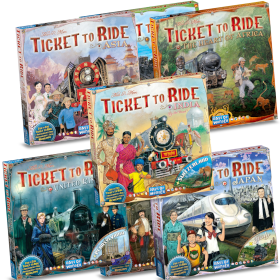 Ticket to Ride is a cross-country train adventure where players collect cards of various types of train cars that enable them to claim railway routes connecting cities in various countries around the world.
Number of players: 2 - 5
Game duration: 11 mn
Complexity: 0 / 5
Play Ticket to Ride Maps and 1394 other games online.
No download necessary - play directly from your web browser.
With your friends and thousands of players from the whole world.
Free.



Play Ticket to Ride Maps and 1394 other games online.
No download necessary - play directly from your web browser.
With your friends and thousands of players from the whole world.
Free.
Rules summary
Summary
Some of the maps have additional rules or different strategies, compared with the original USA version of Ticket to Ride. This gives lots of different variation. Some of these maps were released as separate games in their own right, while others were expansions.
The information below shows the differences for each map, assuming the player is already familiar with the USA version.
India
Introduction
The map of India is designed specifically for 2 to 4 players. In 4 Player games only, players can use both tracks of the double-routes. In 2 and 3 Player games, once one of the tracks of a double-route is taken, the other one is no longer available.
Destination Tickets
This expansion includes 58 Destination Tickets.
At the start of the game, each player is dealt 4 Destination Tickets of which they must keep at least 2. During the game, if a player wishes to draw additional Destination Tickets, they draw 3 new Tickets, of which they must keep at least 1.
Destination Tickets not kept, either at game’s start or following a draw of new Destination Tickets in mid-game, are discarded to the bottom of Destination Tickets deck, as in a regular Ticket to Ride game.
Ferries
Ferries are special gray routes linking two adjacent cities across a body of water. They are easily identified by the Locomotive icon(s) featured on at least one of the spaces making up the route.
To claim a Ferry route, a player must play a Locomotive card for each Locomotive symbol on the route, and the usual set of cards of the proper color for the remaining spaces of that Ferry route.
End Game Bonuses
A 10 point Indian Express bonus is awarded to the player(s) who have the Longest Continuous Path on the board.
Each player may also earn Grand Tour of India bonuses. Any Ticket whose 2 Destination Cities are linked via at least 2 distinct continuous paths of its owner’s plastic trains qualifies for a Grand Tour bonus. These 2 paths may intersect, but cannot share trains.
The size of a player’s bonus varies depending on the number of his qualifying Tickets, as per the Mandala (“Circle” in Sanskrit) bonus table shown on the Map. A player’s first and second qualifying Tickets are worth +5 points each, with the next three worth +10 each. Any qualifying Tickets beyond the fifth one earn no additional points (i.e. the largest bonus a player can receive for his Grand Tour tickets is 40 points).
These bonuses are scored in addition to the points earned for completing the Tickets themselves, of course.
Game Play Hints
Reflecting a country that is both densely populated and colorful, the India map rewards players for claiming key routes early (to avoid being crowded out) and for being careful about which colors they draw.
The Grand Tour bonuses can be used opportunistically or as part of a dedicated strategy.
Bear in mind that:
- The greater the number of qualifying Tickets, the larger the bonus at game end, regardless the length and point value of the individual Tickets
- The last route allowing you to complete a Grand Tour is the most likely to be blocked by an opponent. Try to make sure that you have alternatives for the last route or that it is difficult for your opponent(s) to build on (or both).
Switzerland
Introduction
The map of Switzerland is designed specifically for 2 or 3 players. In 3 Player games only, players can use both tracks of the double-routes. In 2 Player games, once one of the tracks of a double-route is taken, the other one is no longer available.
Destination tickets
At the start of the game, each player is dealt 5 destination tickets, of which they must keep at least 2.
Destination cards that are discarded (including those drawn later in the game) are removed from play. As such, it's possible to run out of destination tickets entirely!
Countries
12 of the destination tickets involve countries, which are completed as follows:
- for tickets between a city and a country, the player must connect from the named city in the centre of the card, to one of the countries shown.
- for tickets between two countries, the player must connect from the primary country to one of the other countries shown. The arrows on the card show which is the primary country.
The player can complete more than one of the routes on each card, however, only the highest scoring route counts at the end of the game. For example, if you complete a route from Bern to Italia (8 points) and also Bern to France (5 points) using the same ticket, you will only score 8 points (not 13).
Locomotive cards
Locomotives are only used with tunnels. They cannot be used on normal routes.
Because of this, they can be picked up like normal train car cards (i.e. a player can pick up 2 locomotives during 1 turn). However, if 3 of the face-up cards are locomotive cards, all the face-up cards are replaced as in the original game.
Tunnels
Tunnels work in the same way as in Ticket to Ride Europe, including the use of locomotives as wildcards. In brief:
Tunnels are identified by the black spiky marking around each of the spaces on the route. The player first needs to lay down the number of cards required. Next 3 cards are drawn from the face-down train car deck. If one or more of the drawn cards matches the colour of the route being claimed, then the player must use the same number of extra cards of that colour (or locomotives) to claim that route. If the player does not have enough cards, they can withdraw their claim, return their cards to their hand, and the cards that were drawn are discarded.
If the player claims a tunnel route using only locomotive cards, then only locomotives drawn from the deck are considered a match, regardless of the colour shown on the board. But also, the extra cards required from the player's hand must also be locomotive cards.
End Game Bonus
A 10 point bonus is awarded to the player(s) who have the Longest Continuous Path on the board.
Nordic Countries
Introduction
The map of Nordic Countries is designed specifically for 2 or 3 players. In 3 Player games only, players can use both tracks of the double-routes. In 2 Player games, once one of the tracks of a double-route is taken, the other one is no longer available.
Destination tickets
At the start of the game, each player is dealt 5 destination tickets, of which they must keep at least 2.
Destination cards that are discarded (including those drawn later in the game) are removed from play. As such, it's possible to run out of destination tickets entirely!
Locomotive cards
Locomotives can only be used with tunnels and ferries, or as part of the extra cards on the Murmansk-Lieksa route. They cannot be used at all on normal routes.
Because of this, they can be picked up like normal train car cards (i.e. a player can pick up 2 locomotives cards during 1 turn). However, if 3 of the face-up cards are locomotive cards, all the face-up cards are replaced as in the original game.
Murmansk-Lieksa route case
Because locomotives cannot be used as direct card replacements, the Murmansk-Lieksa 9-space route allows a player to substitute any chosen four cards (including locomotives) to take the place of one of a needed card. The player may do this multiple times, so, for example, they may play 6 cards of a matching color, plus any other 12 cards to claim the route.
Ferries
Ferries are special routes linking two adjacent cities across a body of water. They are easily identified by the Locomotive icon(s) featured on at least one of the spaces making the route. To claim a Ferry Route:
- For each locomotive shown: the player must play a Locomotive card, or any three chosen cards to replace a locomotive.
- For other spaces: cards matching the color of the remaining slots (or any matching cards for grey routes). A locomotive can be used as a substitute for any of these cards.
Tunnels
Tunnels work in the same way as in Ticket to Ride Europe, including the use of locomotives as wildcards. In brief:
Tunnels are identified by the black spiky marking around each of the spaces on the route. The player first needs to lay down the number of cards required of the matching color (or any matching set for grey). Locomotives can be used for some or all of these cards.
Next 3 cards are drawn from the face-down train car deck. If one or more of the drawn cards matches the colour of the route being claimed, then the player must add the same number of extra cards of that colour (or locomotives) to claim that route. If the player does not have enough cards, they can withdraw their claim, return their cards to their hand, and the cards that were drawn are discarded, and their turn ends.
If the player claims a tunnel route using only locomotive cards, then only locomotives drawn from the deck are considered matches for the tunnel check cards turned up, regardless of the colour shown on the board for the track. However in this situation any locomotives turned up require adding an additional locomotive to claim the route.
End Game Bonus
A 10 point Globetrotter bonus is awarded to the player(s) who has completed the most Destination Tickets.
Asia Countries
This map introduces a rugged terrain and a different end-game bonus.
Mountain Routes:
Several routes feature spaces marked with an "X". To claim these, you must play the standard number of required train cards, plus you must permanently discard one train car from your plastic supply for every "X" on the route.
Mountain Scoring:
Every plastic train discarded to a mountain space is placed in the mountain area on the board and immediately scores 2 bonus points . Because these trains are removed from your supply, you will have fewer trains available to complete other tickets.
Ferries:
Gray ferry routes require you to play a specific number of Locomotive (wild) cards alongside standard colored cards to claim them.
Asian Explorer Bonus:
Instead of the standard Longest Route bonus, a 10-point bonus is awarded to the player who connects the most cities in a single, continuous network.