
Trench
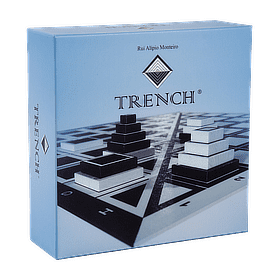 With a design based on the classic strategy games, such as Chess, Checkers, Shogi and Go, TRENCH is a strategy game inspired by the trench warfare during World War I, to bring you the ultimate 2-player challenge!
Two enemy armies, camouflaged on the field — one black and one white — combat on a diamond-shaped 8x8 grid board, full of optical illusions, that is separated by a Trench. This barrier plays a central role in the conflict: occupying it will make the difference in the outcome of the confrontation.
As hostilities between the armies grow, each player attempts to seize control of the Trench in order to take full advantage of its strategic potential, hoping thus to breach the opponent's defenses and capture their most valuable pieces. From the soldier to the General — each one of which possesses its own particular and distinct maneuvers — all will have to cooperate to occupy the Trench, invade the enemy's territory and vanquish the foe. The army that manages to survive after one or at least two battles wins the game!
Number of players: 2
Game duration: 39 mn
Complexity: 3 / 5
Play Trench and 1401 other games online.
No download necessary - play directly from your web browser.
With your friends and thousands of players from the whole world.
Free.



Play Trench and 1401 other games online.
No download necessary - play directly from your web browser.
With your friends and thousands of players from the whole world.
Free.
Rules summary
This page is based on the Official Trench Rules by Rui Alípio Monteiro.
Concept
- Trench is a two-player abstract strategy game inspired by World War I trench warfare, notably on the Western Front.
- Each player commands an army of military units, navigating a diamond-shaped battlefield divided by a dangerous central trench line.
- The mission: outmanoeuvre the enemy and claim control of the field through tactical combat.
Goal of the game
- A player wins by strategically defeating their opponent’s army.
- Through careful movement and combat, the player will gain the upper hand by capturing enemy units and earning points.
The Board and Setup
- The board is 8x8 diamond-shaped*.
- The board is divided by a trench line, separating both armies.
- Each army starts in formation, mirroring each other across the trench.


*Note: for the digital version, there is also the option of orientating the board like a square, in order to use the maximum amount of space available on the screen.
The Units and Movement Directions
| Rank | Maximum
No. of Steps (No. of Points) |
No. of Units
(per player) |
Movement Directions
(Description) |
Movement Directions
Digital (Square) Orientation |
Movement Directions
Classic (Diamond) Orientation |
|---|---|---|---|---|---|
| Soldier | 1 | 6 | Columns and Rows | 
|

|
| Sergeant | 2 | 4 | Columns and Rows
Diagonal forward |

|

|
| Captain | 3 | 3 | Columns and Rows
Diagonals forward and backwards |

|

|
| Colonel | 4 | 2 | Columns and Rows
All diagonals (except backwards!) |

|

|
| General | 5 | 1 | All directions | 
|

|
- Each player controls a total of 16 units.
- All units can move along the columns and rows (both ways). These are the only directions the soldiers can move.
- Units cannot jump over other units.
Movement Overlays per Unit
Caption: selected player unit (in blue); possible moves (in green)
| Rank | Movement Directions
Digital (Square) Orientation |
Movement Directions
Classic (Diamond) Orientation |
|---|---|---|
| Soldier | ||
| Sergeant | ||
| Captain | ||
| Colonel | ||
| General |


Player Turns
- Players take turns moving one unit at a time.
- Black plays first.
- Units move only in one direction per turn (ex.: a unit cannot zig-zag).
- Units may move, per turn, any number of squares, up to its maximum allowed (ex.: a captain can move 1, 2, or 3 squares).
- Note that the maximum number of steps a unit may move equals to the number of points you gain from capturing such unit.
- A player's turn ends after a move or a capture.
- A player cannot pass their turn.
Capturing Units
- A player captures an enemy unit by moving their unit onto the enemy unit's square.
- Only one capture per turn — unless you're exiting the trench (see The Trench Line).
- Captured units are removed from the board.
The Trench Line
Colonels and Generals can move along the trench (since those are the only units that can move sideways).
Advantages
- Units can capture multiple enemy units when exiting the trench and moving forward, and can keep moving even after capturing.


- A unit in the trench is protected from frontal and trench attacks — an enemy unit cannot capture it by advancing from its own side, nor can it capture another unit if both are in the trench.


Disadvantages
- A unit in the trench can be captured from behind — if a player has a unit on the enemy's side, it can move backwards and capture an enemy unit that is inside the trench.


- A unit in the trench cannot move backward to capture a unit in its own friendly territory.


End of the game
- The first player to capture an opponent's pieces worth 25 points wins.
- If 50 consecutive moves are made without any capture (25 moves for each player), the final score determines the winner.